Showing posts with label Bee Info. Show all posts

Saturday, 3 December 2016

How do bees make honey from nectar?

The bees are all busy collecting nectar at this time of year, in the spring.

But what do they do with it? How do they turn it into honey?

The short story is, they change the sugars chemically, and remove water. Let's look at that in more depth:

Collecting nectar

Plants produce nectar in nectaries. Nectar is mostly sucrose and water.

The shiny middle is the nectary, and nectar. This is a manuka flower.
When a forager bee visits, she will suck up the nectar with her long mouth part. She stores the nectar in her sac in front of her stomach.

A bee can carry up to about 40mg, which is the size of a large raindrop. Quite a lot, compared to the size of a bee!

Inside her stomach, enzymes are added. These start the process of converting the sucrose to simple sugars of glucose and fructose.

Back to the hive

The forager returns back to the hive with her load. There she passes the nectar to the mouths of waiting hive bees. 

These bees also add the same enzymes, to continue the chemical changes. 

The processing bees spend about 20 minutes holding droplets out on their 'tongues', so some water can evaporate. 

Evaporation continues

Once the moisture content is down to about 30 - 50% the hive bees put the nectar into cells, just lightly packed and spread on the cell walls.

The bees turn the hive into a huge dehumidifier, and start fanning their wings to circulate warm air throughout the hive to evaporate more moisture from the ripening honey. This works best at night when the outside humidity is lower.

They also move the honey around from cell to cell, gradually increasing the quantity in each cell.

The honey comb cells are capped

When the honey is fully ripe, it is repacked into a new cell, full up, and a wax cap put on the top. This is like putting the lid on a jar of honey - it prevents the honey from reabsorbing moisture.

It's important that the moisture content is kept low, as otherwise the honey will start to ferment, and the sugar change into alcohol, which is toxic to the bees.

Honey qualities

So these marvellous bees have:
  • changed the sugar to glucose and fructose - which is an easily digestible form of energy
  • added other enzymes that create antibacterial properties (this is all honey, not just manuka - manuka has another, extra chemical process)
  • evaporated water so the honey won't ferment
  • made it more acidic, which helps it keep
And then they store it, so the whole colony can survive winter. All pretty special for the animal kingdom.

If you would like to read a bit more of the science-y bits, see the full post at Business of Bees

Thursday, 22 September 2016

Sticky bee droppings on washing

Bees in early spring


If you were a bee in early spring, what do you think would be most on your mind?

Here's a clue: you have been inside for a couple of months. There's not been much to do except cleaning up the queen and larvae's excrement. The weather's been terrible, and you haven't been able to get out.

Oh, and the toilet is outside.

So, the first fine day, everyone rushes the gates and goes out for a poop. They will do their business a bit away from the hive, but not far, say up to 500m.

Bees typically fly in a set flight path between the hive and their current food source. So, if you have your washing hanging out, it's a beautiful day in spring, you have a beehive nearby, and you happen to be on a bee highway...your washing will be covered in sticky yellow bee poop.

So at this point you have a choice:
- to get the sticky yellow stuff out of your washing you will need to soak it for an hour, then wash again.
- if its on your house, then give it a good soak with the hose, and keep it wet for 20 minutes, then wash with soapy water or blast with a pressure hose. That's the theory.
- hang your washing under cover
- hang your washing out at night only - bees don't fly at night, right? - if this works for you let me know, and I'll bring my washing around too.
- talk nicely to the beekeeper and she might give you some honey

But at least you can console yourself with the thought that bees pooing outside the hive is an excellent sign that all is well, and they are healthy. It's the ones pooing inside the hive that is a problem.

For more on this check out Business of Bees

And if you would like to get your free copy of a Pictorial Step by Step Guide to Growing Manuka Trees from Seeds sign up here.

Leave me a comment - do you have a better way to deal with sticky yellow bee poop?

Wednesday, 7 September 2016

Spring pollen for bees from gorse

Gorse in bloom


The bees are up and about now the weather has warmed up. And the queen is awake and started laying eggs again. These eggs will grow into brood, or bee babies, and then hatch out as bees.

But the nurse bees need to keep feeding the brood for them to keep on growing. So the foraging bees need to start hustling.

There isn't much to eat at this time of year though, most plants have not started flowering yet. Luckily we have gorse, that invasive introduced pest plant, that flowers bang on now.

Basically bees collect 2 types of things. Nectar is carbs, and is used to create wax and honey. Pollen is protein and essential nutrients and is required to feed the brood. Gorse produces excellent pollen.

So all these lovely gorse bushes that we chopped down so heartily pre-bees are going to be excellent food for our newly emerging bees. Although when I took this picture I didn't see a single bee visiting. I'm wondering if the flowers weren't quite open enough. I might need to revisit, test out that theory.

For more of the science-y bits around this check out Business of Bees blog post.

And sign up to collect your free downloadable Pictorial Step by Step Guide to Growing Manuka Trees from Seeds. Free! Did I say?

Leave me a comment too, below.

Tuesday, 3 May 2016

Do paper wasps kill bees?

My garden has become infested with paper wasps. They come out in the sun, and love to hang around my clothes line and vegetable garden. On a sunny day I might have 100 or so in close proximity to my clothes hanging activities. Not cool!


There are 2 types of paper wasps, Asian and Australian. Check out this Landcare article for pictures of both.

I've spent ages outside trying to find their nest. Landcare suggests that their nests are small, about the size of a pear. And that they fly no more than 200m. So they must be close.

And AAA pest control Auckland suggests looking at dusk, so you can see them flying in.

Well, I have looked. And looked and looked. I can't see them flying in or out of my place. So that would imply they live in my place. But I can't see them in my place either.

But we've got Vespex, right? That'll deal to them. Except, no.

"Vespex® is specifically designed for wide-area control of Vespula wasp species. In New Zealand, this includes both the common wasp (Vespula vulgaris) and German wasp (V. germanica). These wasps are also known as yellow jackets in some countries."

and that "Paper wasps (Polistes sp.) get the protein they need by hunting for living insects, especially caterpillars, and are not attracted to Vespex®."

But Clemson University says that paper wasps are good for killing garden pests, like caterpillars, of which I have many. Many many. And that paper wasps will die out in the autumn, and the queen will hibernate on her own over winter. Not sure if this applies to our climate, as we don't have hard frosts in Auckland, but fingers crossed.

So maybe I just need to stop hanging my washing out on sunny days?

And keep looking, I think.


And as for 'Do paper wasps kill bees?'. I have no idea. There doesn't seem to be an answer on the interwebs about this. So I am assuming no. Vespula wasps kill bees for sure though.


Saturday, 23 April 2016

Weed killers and bees

How to tell if a weed killer is toxic to bees

Google is a great thing, but also those 2 hours you spend researching something, you never get back, right? I've done quite a bit of research into specific weed killers for our hosts, and thought I would share the better websites that I have found on the way.

Caveat: there isn't AN answer. You can believe what the manufacturers say, or the 'never ever use weedkillers' crowd, or the 'only true if it has been proven by science' crowd - the problem with this last one is that there hasn't to date been a lot of research around all this, bees just got on and did their thing and nobody worried. But now with big problems with Colony Collapse Disorder, especially in the states, more attention is being given to this issue. But any good science takes years, and even then might not produce a definitive answer.

That being said, here is what I came up with:

Say you are going to investigate Conquest.

Its supplied by Nufarm, so if you google it you get the Brochure. Doesn't say what is in it though.


What you want is the label


which lists the active ingredients


picloram and triclopyr in this case.

So let's take Triclopyr - as the butoxyethyl ester:

 (picloram, by the way, was used to make Agent White, and enhanced Agent Orange during the Vietnam War - just saying!)

So on Wikipedia, doesn't say much except that it is "chemically very similar to the herbicide which it generally replaces, 2,4,5-T, which was phased out in the U.S. in the 1970s amid toxicity concerns".

Toxipedia doesn't say much about bees and triclopyr. Although Toxipedia can be quite useful for some chemicals, just not this one. (and Picloram doesn't even get a listing - depends what weed killer you are using as to what information is around).

And then Pesticideinfo which has a whole bunch of science-y information (which both my mother and brother, being chemists, would get all excited about, but the rest of us...not so much).

But down in the Terrestrial Ecotoxicity it does mention bees.


Which might be too tiny to read on this blog, but what it says is it is 'slightly toxic to bees'. And that
"Population-level effects on honeybees may occur even if a pesticide has low acute toxicity. For example, certain pesticides interfere with honeybee reproduction, ability to navigate, or temperature regulation, any of which can have an effect on long-term survival of honeybee colonies. The neonicotinoids, pyrethroids and keto-enol pesticides are some types of pesticides causing one or more of these effects".

So all up, doesn't look dire. Not great either. And I think I would take the bees away before spraying this around. And wait at least the half-life time before bringing the bees back, probably twice the half-life time - which in this case is 39 days see here. So quite a while. (the half life is the time it takes for half the product to be gone, in the soil in this case).

Saturday, 16 April 2016

Pesticides that kill bees


Neonicotinoids kill bees


There is a major class of pesticides  - Neonicotinoids - that is known to kill bees. This is a HUGE problem in the United States, where last year beekeepers lost 42% of honey bee colonies, and neonicotinoids are thought to play an important part in that loss.

One pest control company in the states Ortho, has just announced that they are going to "immediately transition away from the use of neonicotinoid-based pesticides".

Read the whole Huffington post article here including some great links to further resources.

And Wikipedia states that "The neonicotinoid family includes acetamipridclothianidinimidaclopridnitenpyramnithiazinethiacloprid and thiamethoxam. Imidacloprid is the most widely used insecticide in the world."

And it also provides this handy list of which products contain them (this is 2011 data)

NameCompanyProductsTurnover in million US$ (2009)
ImidaclopridBayer CropScienceConfidor, Admire, Gaucho, Advocate1,091
ThiamethoxamSyngentaActara, Platinum, Cruiser627
ClothianidinSumitomo Chemical/Bayer CropSciencePoncho, Dantosu, Dantop439
AcetamipridNippon SodaMospilan, Assail, ChipcoTristar276
ThiaclopridBayer CropScienceCalypso112
DinotefuranMitsui ChemicalsStarkle, Safari, Venom79
NitenpyramSumitomo ChemicalCapstar, Guardian8

We do have our own rules governing the use of neonicotinoids, from the EPA, read about them here. But they basically say you're not to spray near beehives or on flowering plants. So they haven't been banned at all.

Neonicotinoids are used to coat some seeds, and these are still sold in NZ.

Two products available in NZ that contain neonicotinoids are "Yates Confidor" and "Yates Rose Gun Advanced".

Also "They are sold here under the common trade names of Cruiser, Gaucho and Poncho, the active neonicotinoid ingredients of which are thiamethoxam, imidacloprid and clothianidin respectively. Gaucho is also used on potatoes, winter squash and pumpkins."

And from Apicare NZ:

Why neonicotinoids are bad for bees

There has been much talk about this group of insecticides globally.  There are now bans and trial bans in place in many areas around the world.  This is not so in New Zealand, so we need to keep a particular eye out for the ingredients we spray in our gardens and on our farms.  Neonicotinoids work as an insecticide by blocking specific neural pathways in insects’ central nervous systems.  At ‘sub-lethal doses’ the chemicals impair bees’ communication, homing and foraging ability, flight activity, ability to discriminate by smell, learning, and immune systems – all of which have an impact on bees' ability to survive.  Neonicotinoid pesticides have been linked to the dramatic collapse in bee numbers over the last decade.
Domestic Sprays that contain neonicotinoids - Many domestic gardening products on sale in hardware stores and garden centers contain these chemicals.  If you're buying any kind of pest control check the ingredients – anything that contains acetamipridimidaclopridthiacloprid or thiamethoxam should be avoided to maximise bee health.
While the topic of bee safe sprays is relevant topic it is also one that can also be rather confusing. There are so many different garden sprays available in the market place and so many different chemical names, brand names and generic names that making a considered choice can seem impossible. We have tried to simply the issue below by providing some brand names commonly available in the New Zealand market place.
  • There is evidence overseas that the use of a group of pesticides known as neonicotinoids cause bees to become disorientated when out foraging and may be a major contributor to the phenomenon of Colony Collapse Disorder which is decimating bee populations in Europe and North America. Neonicotinoids have also been shown to cause chronic bee mortality through reduced immunity.
  • Bees do not have to come in direct contact with the spray residue, they can absorb the neuro-toxins via the plants pollen and nectar.
  • The common names for neonicotinoid insecticides are Acetamiprid, Clothianidin, Imidacloprid and Thiamethoxam.
  • Neonicotinoids are often used for agricultural applications but can also be available to the home gardener. The two products that New Zealand gardeners are likely to come across (containing Imidacloprid) are Yates Confidor and Yates Rose Gun.
  • It is not just neonicotinords that can be harmful to bees. Other common pesticides that are toxic to them include insecticides containing Acephate, Carbaryl, Spectracide, Permethrin and the rapid flying insect killer Resmethrin, to name a few. Ther is an extensive list on Wikipedia under pesticide toxicity to bees.
  • Sprays that are safe to bees if sprayed at dusk when the bees won’t be foraging for a number of hours (i.e. they are safe to bees as long as they are dry and no longer wet): Spinosad (Yates Success Naturalyte Insect Control), Yates Guardall, Yates Mavrik Insect & Mite Spray, Pyrethrum (Yates Nature's Way Fruit & Vegie Gun, Yates Insect Gun Ready to Use, Yates Natures Way Pyrethrum, and Neem Oil.
  • Sprays that are safe to bees (though it would still be best to spray them at dawn or dusk when bees aren’t flying): Sulfur, Serenade, Insecticidal Soap Based Sprays (Yates Nature's Way Insect & Mite Spray and Yates Mite Killer), Petroleum based oils (Yares Conqueror Spraying Oil), B.T. (bacillus thuringiensis), Herbicides (like round-up).
So if you are at all interested in the survival of honey bees, please DO NOT USE any of these toxic chemicals.

Others are bad too, although not as dire, and in the next post I'll outline how I research these things properly and how you can find out what ingredients are suspect, rather than just relying on the supplier saying it is "not toxic to bees".

Tuesday, 2 February 2016

Washboarding bees

What does it mean when bees rock back and forth at the front of the hive?


One of our hives has had a lot of bees washboarding on the front. All the other hives don't display this behaviour, just this one. And nobody has quite figured out why bees do this.

It just shows you that nature still has it all over us mere humans. Rather beautiful though, don't you think?

(The noise in the background is the ute running, not bees humming. Drat!)


Tuesday, 22 December 2015

Native NZ Bees

Just outside the bedroom window is this Lophomyrtus tree, a NZ native. And a couple of mornings ago it was completely covered with bees. But all the bees were little black native NZ bees. Even though this tree is very close to a whole bunch of hives with regular honey bees, none of them were interested in the flowers, only the little natives were sipping away. But by the afternoon they had all gone, maybe for a bit of a postprandial lie down? Maybe.... because native bees don't live in hives, they only need to collect enough to eat for the day?

.


And for some lovely photos and more information see the Terrain site


Tuesday, 15 December 2015

Breeding Varroa resistant bees

There is scientific work going on to try and overcome varroa, that destructive mite that kills bees. Currently the only way is with chemicals. But check out this short (6 min) Ted talk on this.

There is also a very cool 60 sec video in it, of the first 21 days of a bees life, where you can watch the baby bees hatch.


Tuesday, 1 December 2015

Bees and Wasps


How to tell the difference between bees and wasps? Now I am no expert at all, but the beekeepers are. And it is important to tell the difference, you don't want to squash the wrong thing, or let the wrong thing prosper either. There are a few good summaries online including the Te Ara Encyclopedia


This is a bee, pic from the Ministry of Health. Little furry yellow number, similar to the ones in the hive above.


This one is one type of wasp, pic from Landcare. Smooth and evil looking. Bit Darth Vader really. For more on NZ wasps, including alien pics, check out the Landcare website.


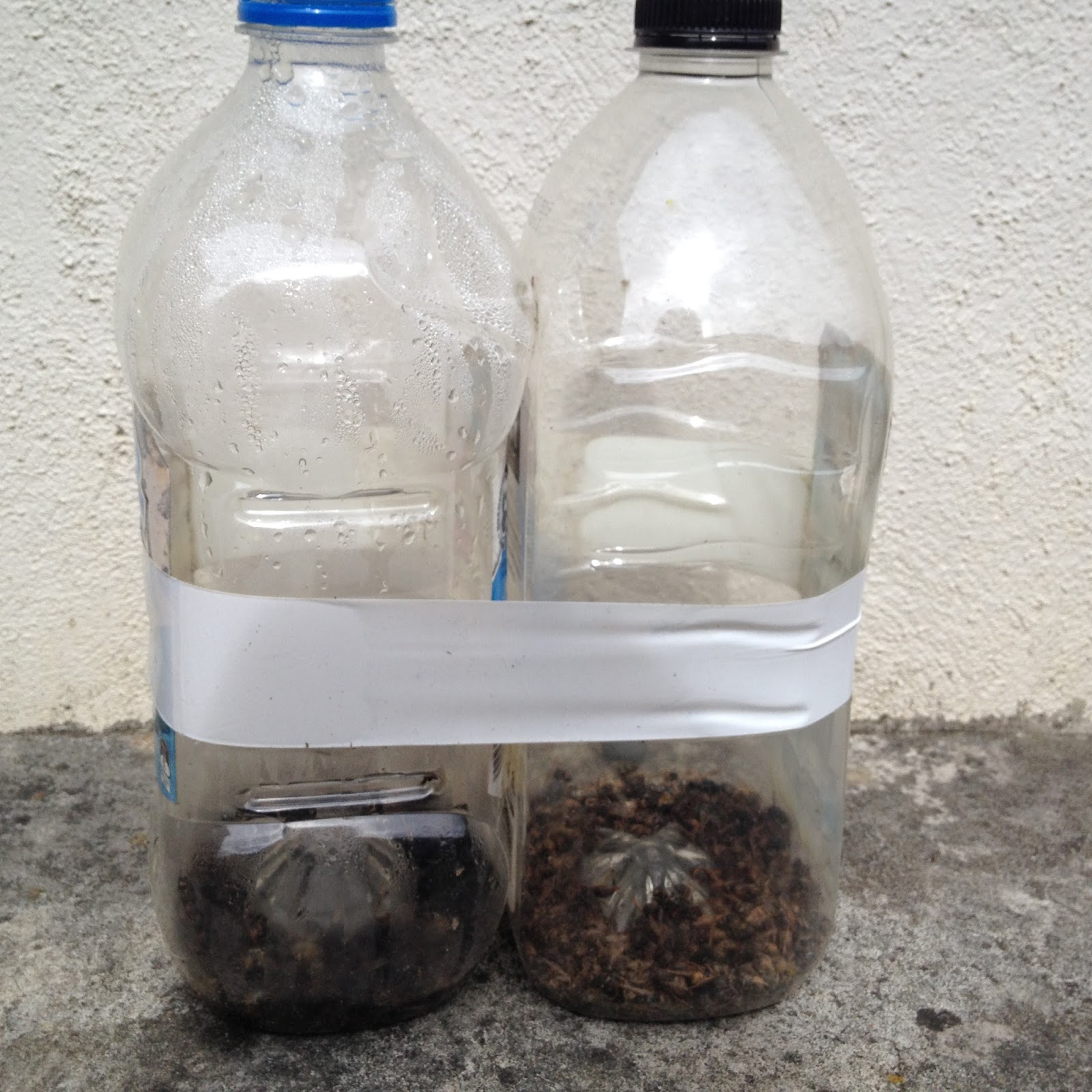
And here are our wasp traps. Recycling in action. It would be better still, instead of trapping them and poisoning the wasps, to find the nests and deal to them that way, but in the bush it can be quite a mission to locate them.


Saturday, 14 November 2015

November is swarming month

About this time of year, in spring, the bees are all growing like mad. Growing, as in, making babies, not getting to horror-movie proportions. And in the wild they cleverly deal with this by making a new queen, and then half the tribe flies off with the old queen to set up a new home, and the other half hatch the new queen and carry on back at the ranch. All good, in the wild.


But in our hives we want to keep all the bees and help them to create new homes where they will be safe. So at this time of year we are always vigilant looking for signs that the hives are ready to swarm. One of these signs is the creation of queen cups. These are little lumps usually at the bottom of the main frame that have the queen larvae in them. And another is overcrowding.

We deal with both of these threats by keeping a close eye on the hives for signs of swarming. And splitting the hives to make 2 out of 1. And adding new boxes to the top so the bees can move up their apartment block and spread out.

Once a hive has swarmed we try to catch it and put it in a new hive so the bees don't just fly off and make their new nest in an inconvenient place. Like a bush, or an old building. Not that easy, and does require being there pretty soon after it has taken off. And if you see a swarm, and don't have a bee suit, its best to leave it alone and call a beekeeper. Nahla, the dog in the picture, got just a bit too close to this swarm!

Tuesday, 10 November 2015

A Cure for Bee Stings


If you ask our bee keepers Will and David, they will say getting stung is a normal part of being a bee keeper, and to just get on with it. But I haven't been stung yet and don't feel the urge to man up either. So I've been researching remedies just in case. And here is my best pick of them:

1. Scrap out the bee sting, don't squeeze it though.
2. Baking soda mixed to a paste with water, then spread on the bite. Something about neutralising the sting. And if it is a wasp you are stung by, then vinegar. Might need to research and do another post on how to tell the difference between a bee and a wasp of course - details details!
3. Ice. Works for everything.
4. Toothpaste, spread on the bite. Similar to baking soda I think.
5. Antihistamine. A cream would work well I think. And if you are mildly allergic I guess an antihistamine pill.

But: of course, if you are extremely allergic, or swell up alarmingly, or stop breathing, then don't do these remedies, call the ambulance.
And for the official advice, always a good idea, visit the Ministry of Health page here.