Thursday, 22 September 2016

Sticky bee droppings on washing

Bees in early spring


If you were a bee in early spring, what do you think would be most on your mind?

Here's a clue: you have been inside for a couple of months. There's not been much to do except cleaning up the queen and larvae's excrement. The weather's been terrible, and you haven't been able to get out.

Oh, and the toilet is outside.

So, the first fine day, everyone rushes the gates and goes out for a poop. They will do their business a bit away from the hive, but not far, say up to 500m.

Bees typically fly in a set flight path between the hive and their current food source. So, if you have your washing hanging out, it's a beautiful day in spring, you have a beehive nearby, and you happen to be on a bee highway...your washing will be covered in sticky yellow bee poop.

So at this point you have a choice:
- to get the sticky yellow stuff out of your washing you will need to soak it for an hour, then wash again.
- if its on your house, then give it a good soak with the hose, and keep it wet for 20 minutes, then wash with soapy water or blast with a pressure hose. That's the theory.
- hang your washing under cover
- hang your washing out at night only - bees don't fly at night, right? - if this works for you let me know, and I'll bring my washing around too.
- talk nicely to the beekeeper and she might give you some honey

But at least you can console yourself with the thought that bees pooing outside the hive is an excellent sign that all is well, and they are healthy. It's the ones pooing inside the hive that is a problem.

For more on this check out Business of Bees

And if you would like to get your free copy of a Pictorial Step by Step Guide to Growing Manuka Trees from Seeds sign up here.

Leave me a comment - do you have a better way to deal with sticky yellow bee poop?

Wednesday, 14 September 2016

Feeding sugar to bees in spring

Feeding bees syrup


One of our most important bee management activities happens right now, in early spring.

We feed the bees sugar syrup.

In Auckland our honey flow - the time of the nectar being ripe on the trees for the bees to collect and turn into honey - starts in about November. So, to make maximum honey, we need maximum bees ready to take advantage of that.

Now from egg to nectar collector (a forager) takes about 6 weeks. So about 6 weeks before honey flow, the bees need to decide to start on the baby production. I mentioned the pollen from gorse in the last blog post but they also need nectar, or nectar substitute.

Which is sugar syrup. You can see in the picture it looks like the syrup is being poured directly into the hive. But there is a feeder box sitting inside the hive beside the brood frames, so the bees can stay in and eat. And also so no foreigners come to dinner.

For some more of the in-depth gumpf on this visit Business of Bees

And for a free downloadable Pictorial Step by Step Guide to Growing Manuka Trees from Seeds sign up here.

Don't forget to share this with your friends.

Wednesday, 7 September 2016

Spring pollen for bees from gorse

Gorse in bloom


The bees are up and about now the weather has warmed up. And the queen is awake and started laying eggs again. These eggs will grow into brood, or bee babies, and then hatch out as bees.

But the nurse bees need to keep feeding the brood for them to keep on growing. So the foraging bees need to start hustling.

There isn't much to eat at this time of year though, most plants have not started flowering yet. Luckily we have gorse, that invasive introduced pest plant, that flowers bang on now.

Basically bees collect 2 types of things. Nectar is carbs, and is used to create wax and honey. Pollen is protein and essential nutrients and is required to feed the brood. Gorse produces excellent pollen.

So all these lovely gorse bushes that we chopped down so heartily pre-bees are going to be excellent food for our newly emerging bees. Although when I took this picture I didn't see a single bee visiting. I'm wondering if the flowers weren't quite open enough. I might need to revisit, test out that theory.

For more of the science-y bits around this check out Business of Bees blog post.

And sign up to collect your free downloadable Pictorial Step by Step Guide to Growing Manuka Trees from Seeds. Free! Did I say?

Leave me a comment too, below.

Thursday, 1 September 2016

September is Bee Awareness Month

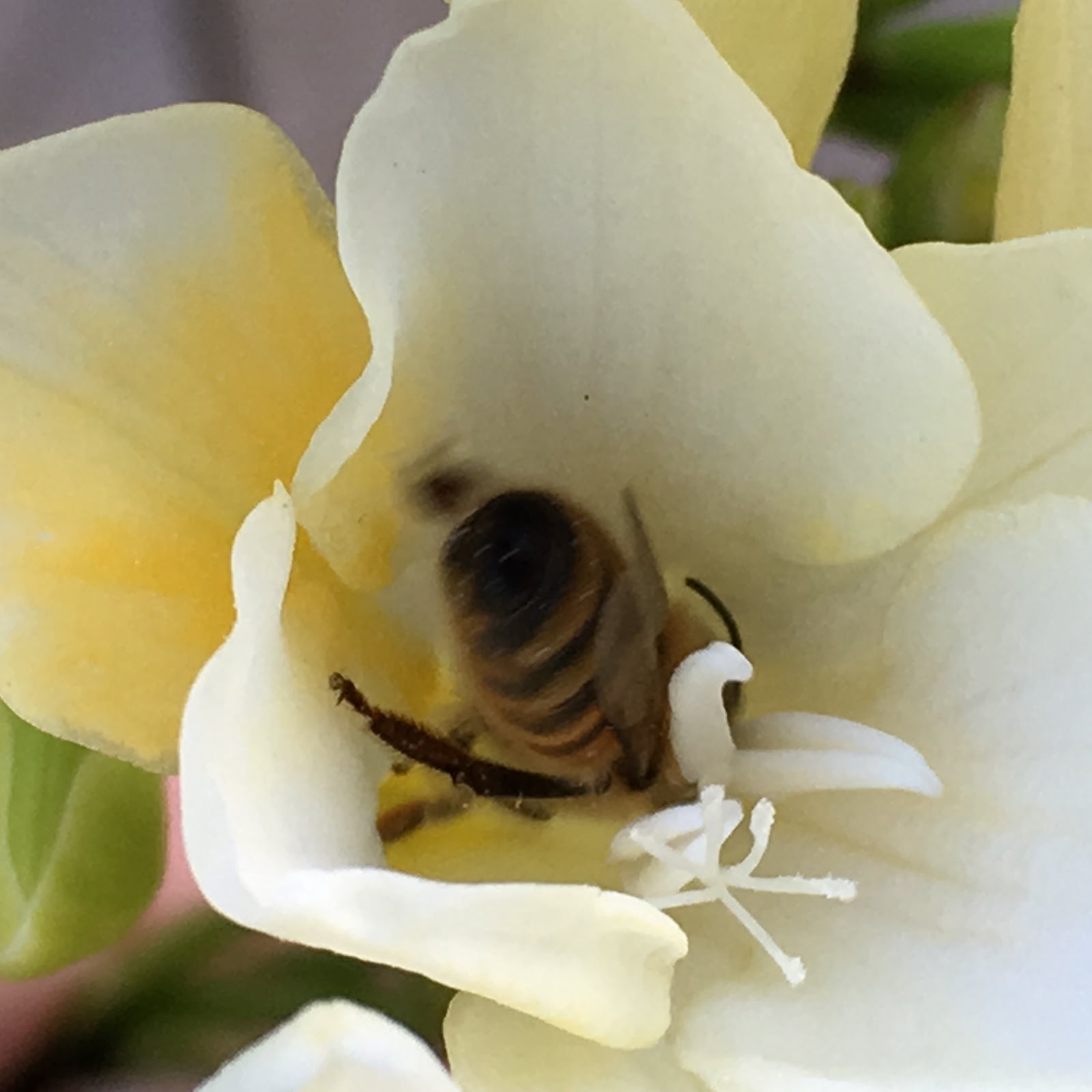
A bee in winter in a freesia flower


Here it is, already September. Are we getting old or what?

But, good news! Its officially spring.

And it's also the start of Bee Awareness Month. The good folk at NZ Gardener have set up 2 things for us to do this year.

You can register your bee friendly plantings of this spring on their Plan Bee map. The map looks like this. And for bonus points you get to name your place - so here's the chance to live in 'Queen Bee Karen's Palace' or whatever it is that takes your fancy. Can't ask for better than that!

But wait, that's not all...this year also they have created a Great Kiwi Bee Count. This is a joint programme between NZ Gardener and the scientists at Plant and Food Research.

Here's my early bee above. She was out in early August (so doesn't qualify for the count), but was quite persistent in supping away, even though I was holding this bunch of picked flowers.

I'm guessing that all you beekeepers out there don't need to do a bee count. Might not be quite what the scientists had in mind.

Leave me a comment below, and tell me what you want to know and I'll see what I can do for you. And remember to check out Business of Bees

Friday, 26 August 2016

Planting manuka trees time

OK, so we know that the best time to plant manuka trees is autumn and winter. Then they have a good chance of establishing roots and getting lots of water before they start growing like crazy in spring.

And now its one week off September, and then officially spring. Eek. And yippee.

Our bees have certainly figured out it's spring, last weekend they were out in force.


But, its been raining and raining all winter. And raining, did I say? Not such great weather for the humans planting the trees. And on a lazy Sunday, get all rugged up in the gumboots and coat? Nah. But no worries, we planted some last weekend. Still winter, right?


Here you go:
1. Dig hole
2. Add compost
3. Bung in tree
4. Press down a bit.


Some of our new trees even have flowers. I would be picking these are the ones that we made from cuttings, which helps them reach maturity a lot earlier.

For more pictures (and words) check out Business of Bees Blog.

And, from the hot-of-the-press department, the new Pictorial Guide to Growing Manuka from Seeds (FREE!) is now available. So go on, go and download it and enjoy!

Don't forget to share it with your friends too. And add your comments below.


Saturday, 20 August 2016

Manuka Honey Madness


Why is this sight of stacks of beehives going to become more familiar?

The manuka honey industry is growing like mad. The annual value of honey exports is up by 45% to $286mill in the 12 months to December 2015.

Did you catch that? 45% increase! Little old NZ!

So what does this mean? And why is it happening?

Manuka honey stats


Well, it's all from our manuka honey. And guess what? No one else makes manuka honey. IN THE WORLD!

Check out my blog post here on Business of Bees for all the in-depth stats and analysis, but the executive summary is that NZ is punching way above our weight in terms of value of honey exports. We are right up near the top in terms of $ value, although not for volume.

Which means manuka honey is much more expensive than other honeys. Well, we know this...I bought a 500g jar of honey at the market for $60 last weekend. $60! To spread on my toast!

Another great reason to get into this industry


So say you don't actually want to deal with the bees; cute furry little creatures, but they do sting. Well, how about planting manuka?

All those beekeepers are going to need manuka trees to put their beehives near, right? 

It's estimated that a new manuka plantation on marginal hill country can return 10-15% yearly on the cost of establishment.

For more on this check out the resources on Business of Bees


Tuesday, 9 August 2016

Why is the NZ honey industry going crazy?

If you wanted to invest in an industry that was growing exponentially, then beekeeping is the thing. For this decade at least.

So, what's been happening?

Back in 2010 there were around 3000 registered beekeepers.
By September this year (2016) it is expected there will be 7000 registered beeks.
That's a crazy increase of 4000, or more than double (133% increase) in only 6 years.

But that's not all....Back in 2010 there were around 375,000 hives, give or take a few.
By September its expected there will be 700,000 hives. That's 186% increase.

And why? Because of the amazing, and recently discovered, properties of manuka honey and its application in medical and hospital situations. The price for a kg of true manuka honey is just rocketing. And, not unlike the Auckland house market, if I put a price on it here, it'll be out-of-date before you know it. So I'll stick to words like thriving, and flourishing, and gangbusters.

You get the picture.

If you want to read more in depth about this, and get a few more gnarly stats, check it out here. You can sign up to my email list for updates and free information here too. And don't forget to make a comment below.